Putting People First: Waupaca’s Blueprint for a Modern, Safer Foundry

08 April 2026

Putting People First:       Waupaca’s Blueprint for a Modern, Safer Foundry

In today’s foundry landscape, success starts with people. As the labor market tightens, creating a safer, more comfortable workplace is a necessity for attracting and retaining skilled operators.

A recent feature in Modern Casting showcases how Waupaca Foundry (Plant 1) tackled two of the industry’s most persistent challenges: silica dust and excessive noise.

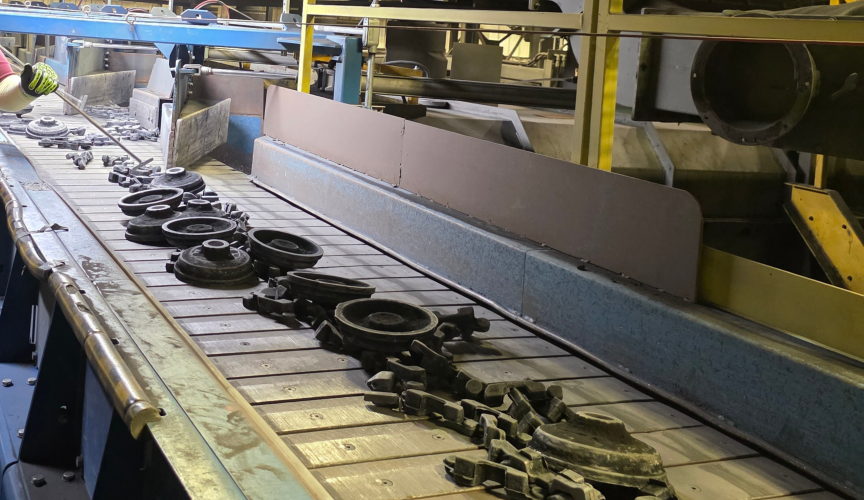
For years, the team relied on a 90-foot vibratory conveyor for casting sorting. Despite significant investments in dust collection and sound barriers, conditions remained largely unchanged:

  • Noise levels frequently exceeded 100 dB, requiring double hearing protection
  • Silica exposure averaged 75 μg/m³, making respirators mandatory
  • Harsh conditions made worker retention an ongoing challenge

The turning point came when Waupaca replaced the vibratory system with the innovative Magaldi Superbelt® conveyor for automatic casting sorting - a solution designed to eliminate the root causes of dust and noise rather than simply mitigate them. The results were transformative!

👉 Read the full technical breakdown and the testimonials from the Waupaca team in the March issue of Modern Casting.

  • Download the article

    1.96 Mb - PDF
    Download

Download File

Enter the necessary information to proceed with the download
News

Poland’s Waste-to-Energy Expansion Makes Incinerator Bottom Ash a Strategic Resource

19 February 2026

As Poland rapidly scales its thermal treatment capacity toward the 4.2 Mt/year target, a crucial question remains: are you still paying to bury your profits? With the KPGO 2028 targets in sight, Incinerator Bottom Ash (IBA) is no longer a waste to be landfilled but a massive stream of recoverable metals and minerals. Traditional wet systems are becoming a financial drag, degrading metal quality and inflating disposal costs. Are you leaving value on the table for someone else to monetize? Discover how the shift toward dry management solutions, like MADAM (Magaldi Dry Ash Management), is redefining the economics of Polish WtE projects, turning disposal liabilities into high-purity secondary raw materials and boosting plant EBITDA.

Read More

News

WtE: Data-Driven Decisions with Magaldi’s Mobile Test Facility

29 September 2025

Every ton of Incinerator Bottom Ash (IBA) holds untapped metal recovery potential, but uncertainty holds back investment. Magaldi’s Ash Insight Unit, a mobile on-site testing facility, gives Waste-to-Energy operators real data under real conditions, eliminating guesswork and enabling smart, scalable decisions. From accurate feasibility studies to full-scale IBA treatment with the MADAM system, Magaldi turns IBA into opportunity - because smart investment starts with knowing what’s inside.

Read More

News

TrAsh or Treasure? The Circular Promise of Dry Ash Management

01 July 2025

Every ton of municipal solid waste processed in WtE plants contains valuable metals hidden within Incinerator Bottom Ash (IBA). Recovering these metals offers a significant opportunity, with potential revenues reaching up to €30 per ton of waste. Moreover, recycling these materials could prevent 20–30 million tons of CO₂ emissions each year. MADAM (MAgaldi Dry Ash Management) system transforms this process by keeping IBA dry, which enhances recovery rates and preserves the quality of the metals. This innovative approach not only increases market value but also contributes to substantial carbon savings.

Read More

News

Breaking the Waste Cycle: How Dry IBA Management Can Disrupt Landfill Dependency and Ash Pond Pollution

24 June 2025

We burn waste to keep it out of landfills - but what about the ash? If untreated or poorly managed, Incinerator Bottom Ash (IBA) becomes just another form of waste destined for landfills or ash ponds, thus undermining the circularity promise of WtE systems. The Magaldi Dry Ash Management (MADAM) system tackles this critical gap by drastically reducing the amount of IBA sent to landfill and transforming it into a cleaner, high-quality material suitable for reuse.

Read More